
Friday, January 2, 2009

Monday, December 15, 2008
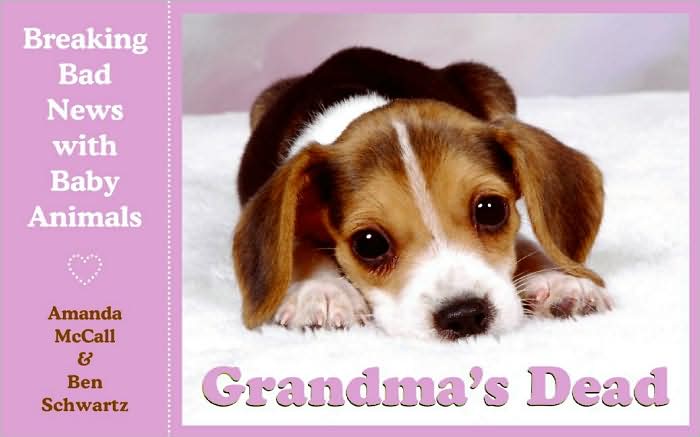
Grandma's Dead
Saturday, December 6, 2008
Comet Chair and Ottoman
It's not for me (I think it's the salmon color), but I can't deny that it's cute.

Cute Cues:
Cute Cues:
- Short, Stubby Legs
- Wobbliness (Legs splay, which reminds me a bit of Bambi trying to walk on ice.)
- Disproportion (The seat is quite oversized.)
- Roundness
- Simple Geometry
Mini Classic Furniture
"Cute" isn't the first thing you think when you take a look at the Eames Lounge, but when it's this tiny, I sure do. And they add a cute little monkey for good measure.

Via Apartment Therapy
Well, I've given my final presentation and therefore moved onto the next phase in my project––furniture design. I won't be doing any this semester, but the next few weeks are going to be spent getting cute furniture inspiration (finally!). So I may have the odd cute kitten video, but furniture is the focus now.
Via Apartment Therapy
Well, I've given my final presentation and therefore moved onto the next phase in my project––furniture design. I won't be doing any this semester, but the next few weeks are going to be spent getting cute furniture inspiration (finally!). So I may have the odd cute kitten video, but furniture is the focus now.
Thursday, December 4, 2008
Sunday, November 23, 2008
VW Poster Part 2
Well, I couldn't help it, but at least I can cross something off my to do list. Here's my informational poster (pre-critique) on The Science of Cute:


Saturday, November 22, 2008

Friday, November 21, 2008
VW Poster
I've been working on ideas for my final poster for the project, and have come up with the idea of showing one of my case studies. It was important for me to show a product as opposed to a baby or animal, as this is for a design studio. And it was also imperative that I use a popular product, one that people have seen often, in order to be familiar with its cute features.
So, I decided on the VW Bug. I wanted to show it extra large, front and center, but couldn't find an image large enough, so I decided to make one myself, using Illustrator:

And here it is in a few choice colors.

So, I decided on the VW Bug. I wanted to show it extra large, front and center, but couldn't find an image large enough, so I decided to make one myself, using Illustrator:

And here it is in a few choice colors.

Thursday, November 13, 2008


Tuesday, November 4, 2008
Logo
I have come up with a name for the book I am making that contains all the research I have been doing:
OMG, Cute! The Science Behind a Cultural Phenomenon
I may want to change the subtitle to something involving "design," but I'm not sure what that would be yet. I have also designed the graphic that will be used for the cover, the presentation, and the promotional poster.
.jpg)
I have decided on making two books for my thesis, one for each semester. The first, a pink book with a white logo, will be my "design brief" and include my research. The second, a white book with a pink logo, will document the design phase, from initial sketches to built project.
OMG, Cute! The Science Behind a Cultural Phenomenon
I may want to change the subtitle to something involving "design," but I'm not sure what that would be yet. I have also designed the graphic that will be used for the cover, the presentation, and the promotional poster.
.jpg)
I have decided on making two books for my thesis, one for each semester. The first, a pink book with a white logo, will be my "design brief" and include my research. The second, a white book with a pink logo, will document the design phase, from initial sketches to built project.
Wednesday, October 29, 2008
Pandamania: Hard-Wired
Meaghan Wolff wrote an article for The Washington Post on the biological reasons behind our reaction to cuteness. She cites Psychology professor Stephan Hamann's various studies on the brain's reaction to pleasant stimuli.
"[Hamann] has conducted a number of studies on brain responses to pleasant stimuli, including pictures of cute baby seals and puppies. He uses functional magnetic resonance imaging (fMRI), which is sensitive enough to measure tiny changes in brain activity.
Hamann's studies found that "cute" pictures cause increased activity in the middle area of the orbital frontal cortex, located behind the bridge of the nose, and in the amygdala, the emotion-control center of the brain responsible for fear and arousal.
According to Hamann, increased activity in the middle orbital cortex is usually associated with pleasure and positive emotion. Some evidence suggests the brain activity there is greater when the stimulus is "neotenous," which is to say it has juvenile characteristics -- a button nose, big eyes, a large wobbly head, chubby extremities or pudgy cheeks."
"Men and women showed nearly identical responses to cute stimuli, even if for social reasons they rate it differently."
"[Hamann] has conducted a number of studies on brain responses to pleasant stimuli, including pictures of cute baby seals and puppies. He uses functional magnetic resonance imaging (fMRI), which is sensitive enough to measure tiny changes in brain activity.
Hamann's studies found that "cute" pictures cause increased activity in the middle area of the orbital frontal cortex, located behind the bridge of the nose, and in the amygdala, the emotion-control center of the brain responsible for fear and arousal.
According to Hamann, increased activity in the middle orbital cortex is usually associated with pleasure and positive emotion. Some evidence suggests the brain activity there is greater when the stimulus is "neotenous," which is to say it has juvenile characteristics -- a button nose, big eyes, a large wobbly head, chubby extremities or pudgy cheeks."
"Men and women showed nearly identical responses to cute stimuli, even if for social reasons they rate it differently."
Tuesday, October 28, 2008
The Cute Show
An episode of "The Cute Show," this one featuring hedgehogs. Favorite part: the hedgehog slo-mo, hands down. It's like hedgehog karate. Hilarious!
From vbs.tv.
From vbs.tv.
Everything's Bigger in Texas
Today marks a proud day in history, as Carnival Cruise Lines broke the world record for "World's Largest Beach Ball" today in downtown Dallas, Texas. The ball neasures 3 stories tall. Awesome? Yes. Cute? Definitely!
Just look at this video taken at the dropping of the beach ball:
I laughed out loud when all the people put their hands up in anticipation to hit the ball. It reminds me of that part in Toy Story where all the aliens are in the claw machine and they look up at the claw and go, "Ooooooo."
This event calls out to our inner children, I believe. Adults have forsaken work time for play time, if only for a few minutes, and I think part of the cute connection relies on the playfulness that this depicts.
Cute Cues:

Just look at this video taken at the dropping of the beach ball:
I laughed out loud when all the people put their hands up in anticipation to hit the ball. It reminds me of that part in Toy Story where all the aliens are in the claw machine and they look up at the claw and go, "Ooooooo."
This event calls out to our inner children, I believe. Adults have forsaken work time for play time, if only for a few minutes, and I think part of the cute connection relies on the playfulness that this depicts.
Cute Cues:
- Roundness
- Unsteadiness (Slowness)
- Smallness in comparison to other objects (People are dwarfed)

Monday, October 27, 2008

Hello Kitty

Cute Cues:
- Small nose
- Eyes and nose set on lower half of head
- Large ears
- Large, rounded head
- Simple geometry
Other points of interest:
- Innocence portrayed by bow tie
- Lack of mouth/voice
Opinions to be developed further. Quotes to be gathered.
Kawaii: The Culture of Cute
Excerpts from Natalie Avella's Graphic Japan: From Woodblock and Zen to Manga and Kawaii.
A Brief History of Kawaii
"Kawaii, meaning 'cute,' must be one of the most loved and most widely used words in Japan. Kawaii essentially means 'childlike,' and, according to academic Sharon Kinsella, who has studied the phenomenon, it celebrates all that is: 'sweet, adorable, innocent, pure, simple, genuine, gentle, vulnerable, weak, and inexperienced in social behavior and physical appearance.' ...The word kawaii is derived from kawajushi, a word that first appeared in dictionaries prior to 1945. It had principal meanings of 'shy' or 'embarrassed,' but possessed secondary meanings such as 'pathetic,' 'vulnerable,' 'darling,' 'loveable,' and 'small.'" (211-213)
"Kawaii first appeared in the 1970s, at the same time as the emergence of a new craze among teenagers, especially girls, for cute, babyish handwriting, ...[which was a rebellion] against traditional Japanese culture and identifying with European culture. ...As the handwriting craze developed, so did a fashion among young adults for childish behavior, baby-talk, and wearing childish clothes. ...Dressing up continues to be practiced by Japanese youth." (213)

"A love of cute characters appears to transcend both age and gender." (211)
"Cute is not just eye candy on the surfaces of consumer products; kawaii characters also function as a polite way of conferring guidance and information to the public. ...In a country where people are brought up on a diet of manga and anime, cartoons are a common language." (212)
"Creating quasi-relationships with cute, inanimate objects is a relief from, or compensation for, the alienation that many people feel." (214)
"For corporate business, kawaii helps to give a friendly face to an otherwise impersonal corporate identity, giving people a way to build a personal relationship with a particular brand." (212)
"Japanese tend to enjoy funny topics for daily conversation, such as 'what kind of dumb things they've done,' or descriptions of their own mistakes. This is an attempt to disarm the listener, and to develop more intimate relationships. Similarly, funny mascots tell you that the owner is friendly and unpretentious." (212)
"In Japan, group harmony is valued above individual expression." (214)
Other Sources for Studies on Kawaii
"Modern consumers might not be able to meet and develop relationships enough with people, but the implication of cute goods design was that they could always attempt to develop them with cute objects." Source: Kinsella, Sharon. "Cuties in Japan." Women, Media and Consumption in Japan. University of Hawaii Press.
"Kawaii gives people a way to hang onto childhood and thereby postpone the pressures of adulthood. ...Adulthood was not viewed as a source of freedom and independence, it was viewed as quite the opposite, as a period of restrictions and hard work. ...Cute fashions idolize childhood because it is seen as a place of individual freedom unattainable in society." (Kinsella)
"Wearing a cute mascot in public is a way to communicate with others like yourself. There is a consensus that a person who likes cute things is good. If you show a funny mascot, people assume that you are an easy-going and open-minded person. Your mascot makes people around you believe you are more approachable. The mascot also" Source: Kato, Miki. "Cute Culture." Eye. Issue 44 Summer 2002.
"If you invite a Japanese acquaintance to dinner, and ask them what kind of restaurant they would like to go to, they will probably answer, 'anywhere you like.' Not having an individual voice is considered a traditional virtue in Japan and this is based on the idea of amae," which means to "act like a child." (Kato)
A Brief History of Kawaii
"Kawaii, meaning 'cute,' must be one of the most loved and most widely used words in Japan. Kawaii essentially means 'childlike,' and, according to academic Sharon Kinsella, who has studied the phenomenon, it celebrates all that is: 'sweet, adorable, innocent, pure, simple, genuine, gentle, vulnerable, weak, and inexperienced in social behavior and physical appearance.' ...The word kawaii is derived from kawajushi, a word that first appeared in dictionaries prior to 1945. It had principal meanings of 'shy' or 'embarrassed,' but possessed secondary meanings such as 'pathetic,' 'vulnerable,' 'darling,' 'loveable,' and 'small.'" (211-213)
"Kawaii first appeared in the 1970s, at the same time as the emergence of a new craze among teenagers, especially girls, for cute, babyish handwriting, ...[which was a rebellion] against traditional Japanese culture and identifying with European culture. ...As the handwriting craze developed, so did a fashion among young adults for childish behavior, baby-talk, and wearing childish clothes. ...Dressing up continues to be practiced by Japanese youth." (213)

"A love of cute characters appears to transcend both age and gender." (211)
"Cute is not just eye candy on the surfaces of consumer products; kawaii characters also function as a polite way of conferring guidance and information to the public. ...In a country where people are brought up on a diet of manga and anime, cartoons are a common language." (212)
"Creating quasi-relationships with cute, inanimate objects is a relief from, or compensation for, the alienation that many people feel." (214)
"For corporate business, kawaii helps to give a friendly face to an otherwise impersonal corporate identity, giving people a way to build a personal relationship with a particular brand." (212)
"Japanese tend to enjoy funny topics for daily conversation, such as 'what kind of dumb things they've done,' or descriptions of their own mistakes. This is an attempt to disarm the listener, and to develop more intimate relationships. Similarly, funny mascots tell you that the owner is friendly and unpretentious." (212)
"In Japan, group harmony is valued above individual expression." (214)
Other Sources for Studies on Kawaii
"Modern consumers might not be able to meet and develop relationships enough with people, but the implication of cute goods design was that they could always attempt to develop them with cute objects." Source: Kinsella, Sharon. "Cuties in Japan." Women, Media and Consumption in Japan. University of Hawaii Press.
"Kawaii gives people a way to hang onto childhood and thereby postpone the pressures of adulthood. ...Adulthood was not viewed as a source of freedom and independence, it was viewed as quite the opposite, as a period of restrictions and hard work. ...Cute fashions idolize childhood because it is seen as a place of individual freedom unattainable in society." (Kinsella)
"Wearing a cute mascot in public is a way to communicate with others like yourself. There is a consensus that a person who likes cute things is good. If you show a funny mascot, people assume that you are an easy-going and open-minded person. Your mascot makes people around you believe you are more approachable. The mascot also" Source: Kato, Miki. "Cute Culture." Eye. Issue 44 Summer 2002.
"If you invite a Japanese acquaintance to dinner, and ask them what kind of restaurant they would like to go to, they will probably answer, 'anywhere you like.' Not having an individual voice is considered a traditional virtue in Japan and this is based on the idea of amae," which means to "act like a child." (Kato)
A Biological Homage to Mickey Mouse
Snippets from a short article written by Stephen Jay Gould (in his larger collection of articles called The Panda's Thumb), centered on Mickey Mouse's evolution during 50 years.
"The original Mickey was a rambunctious, even slightly sadistic fellow. ...As Mickey's personality softened, his appearance changed. Many Disney fans are aware of this transformation through time, but few (I suspect) have recognized the coordinating theme behind all the alterations. ...In short, the blander and inoffensive Mickey became progressively more juvenile in appearance." (95-97)

Copyright Walt Disney Productions
"To give him the shorter and pudgier legs of youth, [Disney artists] lowered his pants line and covered his spindly legs with a baggy outfit. (His arms and legs also thickened substantially–and acquired joints for a floppier appearance.) His head grew relatively larger and its features more youthful. The length of Mickey's snout has not altered, but decreasing protrusion is more subtly suggested by a pronounced thickening. Mickey's eye has grown in two modes: first, by a major, discontinuous evolutionary shift as the entire eye of the ancestral Mickey became the pupil of his descendants, and second, by gradual increase thereafter. ...Mickey's ears moved back, increasing the distance between nose and ears, and giving him a rounded, rather than sloping, forehead." (98-99)
These features match almost perfectly with Lorenz' features of youth: "a relatively large head, predominance of the brain capsule, large and low-lying eyes, bulging cheek region, short and thick extremities, a springy elasticity, and clumsy movements."
"[We must] ask why Disney chose to change his most famous character so gradually and persistently in the same direction? ...The abstract features of human childhood elicit powerful emotional responses in us, even when they occur in other animals. I submit that Mickey Mouse's evolutionary road down the course of his own growth in reverse reflects the unconscious discovery of this biological principal by Disney and his artists. ...To this extent, the magic kingdom trades on biological illusion–our ability to abstract and our propensity to transfer inappropriately to other animals the fitting responses we make to changing form in the growth of our own bodies." (100-104)
Basically, Mickey changed in order to keep with one of Walt Disney's many rules of thumb: "Keep it cute!"

Copyright Walt Disney Productions
"The original Mickey was a rambunctious, even slightly sadistic fellow. ...As Mickey's personality softened, his appearance changed. Many Disney fans are aware of this transformation through time, but few (I suspect) have recognized the coordinating theme behind all the alterations. ...In short, the blander and inoffensive Mickey became progressively more juvenile in appearance." (95-97)

Copyright Walt Disney Productions
"To give him the shorter and pudgier legs of youth, [Disney artists] lowered his pants line and covered his spindly legs with a baggy outfit. (His arms and legs also thickened substantially–and acquired joints for a floppier appearance.) His head grew relatively larger and its features more youthful. The length of Mickey's snout has not altered, but decreasing protrusion is more subtly suggested by a pronounced thickening. Mickey's eye has grown in two modes: first, by a major, discontinuous evolutionary shift as the entire eye of the ancestral Mickey became the pupil of his descendants, and second, by gradual increase thereafter. ...Mickey's ears moved back, increasing the distance between nose and ears, and giving him a rounded, rather than sloping, forehead." (98-99)
These features match almost perfectly with Lorenz' features of youth: "a relatively large head, predominance of the brain capsule, large and low-lying eyes, bulging cheek region, short and thick extremities, a springy elasticity, and clumsy movements."
"[We must] ask why Disney chose to change his most famous character so gradually and persistently in the same direction? ...The abstract features of human childhood elicit powerful emotional responses in us, even when they occur in other animals. I submit that Mickey Mouse's evolutionary road down the course of his own growth in reverse reflects the unconscious discovery of this biological principal by Disney and his artists. ...To this extent, the magic kingdom trades on biological illusion–our ability to abstract and our propensity to transfer inappropriately to other animals the fitting responses we make to changing form in the growth of our own bodies." (100-104)
Basically, Mickey changed in order to keep with one of Walt Disney's many rules of thumb: "Keep it cute!"

Copyright Walt Disney Productions
Sunday, October 26, 2008
Egg Pants
Saw these a while back and made a mental note to post them here. They are adorable!


They're available at Design Glut.
Cute cues:


Egg Pants have three stubby "legs" which will keep your breakfast eggs standing tall. They're white on the outside and yellow on the inside, just like the eggs they hold.
While the material looks like ceramic, it is actually quite soft and flexible. The flexibility allows these little cups to stretch and give a perfect fit to all different sizes of eggs.
Dip-molded PVC.
They're available at Design Glut.
Cute cues:
- Anthropomorphism (Clothing for an inanimate object)
- Roundness
- Short, stubby appendages
Emotional Design
The following are a few choice quotes from Donald A. Norman's Emotional Design: Why We Love (or Hate) Everyday Things:
"[We have a] tendency to read emotional responses into anything, animate or not. We are social creatures, biologically prepared to interact with others, and the nature of that interaction depends very much on our ability to understand another's mood. Facial expressions and body language are automatic, indirect results of our affective state, in part because affect is closely tied to behavior. ...We have evolved to interpret even the most subtle of indicators. ...Interpretations of inanimate objects might seem bizarre, but the impulse comes from the same source–our automatic interpretive mechanisms. We interpret everything we experience, much of it in human terms. This is called anthropomorphism, the attribution of human motivations, beliefs, and feelings to animals and inanimate things. The more behavior something exhibits, the more we are apt to do this." (135-136)
This relates well to Lorenz' Innate Releasing Mechanism, an involuntary biological response to an experience.

Stefano Pirovano's Te o Tea Strainer, made by Alessi.
"At first sight, the arms and legs of the figure are simply cute, but when it becomes apparent that the cuteness is also functional, then 'cute' becomes transformed into 'pleasure' and 'fun,' and this, moreover, is long-lasting. ...I spent much of the next hour trying to understand what transforms an impression of shallow cuteness into one of deep, long-lasting pleasure." (106)

"The essence of the surprise was the separation between the two viewings: first the tea strainer alone, then on the teacup. ...What transforms the strainer from 'cute' into 'fun'? Is it surprise? Is it cleverness? Certainly both of those traits play a big role." (106)
Here, Norman relates cuteness with pleasure, which brings me to designer and human factors expert Patrick Jordan's Four Kinds of Pleasure:
Norman also states that 'fun' and 'pleasurable' are still very elusive concepts.
"What is delightful depends a lot upon the context. The actions of a kitten or human baby may be judged fun and cute, but the very same actions performed by a cat or human adult can be judged irritating or disgusting." (106)
He suggests that more than one type of pleasure is in play at any one time. Visual cues may be what initially attracts you to a kitten, but the socio-pleasure you get from interaction with the kitten or the mental high you get from playing with the kitten (the psycho-pleasure) are what forge the bond between you and the animal.
"[We have a] tendency to read emotional responses into anything, animate or not. We are social creatures, biologically prepared to interact with others, and the nature of that interaction depends very much on our ability to understand another's mood. Facial expressions and body language are automatic, indirect results of our affective state, in part because affect is closely tied to behavior. ...We have evolved to interpret even the most subtle of indicators. ...Interpretations of inanimate objects might seem bizarre, but the impulse comes from the same source–our automatic interpretive mechanisms. We interpret everything we experience, much of it in human terms. This is called anthropomorphism, the attribution of human motivations, beliefs, and feelings to animals and inanimate things. The more behavior something exhibits, the more we are apt to do this." (135-136)
This relates well to Lorenz' Innate Releasing Mechanism, an involuntary biological response to an experience.

Stefano Pirovano's Te o Tea Strainer, made by Alessi.
"At first sight, the arms and legs of the figure are simply cute, but when it becomes apparent that the cuteness is also functional, then 'cute' becomes transformed into 'pleasure' and 'fun,' and this, moreover, is long-lasting. ...I spent much of the next hour trying to understand what transforms an impression of shallow cuteness into one of deep, long-lasting pleasure." (106)

"The essence of the surprise was the separation between the two viewings: first the tea strainer alone, then on the teacup. ...What transforms the strainer from 'cute' into 'fun'? Is it surprise? Is it cleverness? Certainly both of those traits play a big role." (106)
Here, Norman relates cuteness with pleasure, which brings me to designer and human factors expert Patrick Jordan's Four Kinds of Pleasure:
- Physio-pleasure: Sights, sounds, smells, taste, and touch.
- Socio-pleasure: Derived from interaction/communication with others. Usage.
- Psycho-pleasure: Deals with one's reactions and psychological state during use or interaction. Resides at behavioral level.
- Ideo-pleasure: Reflection of the experience/interaction. Appreciation of object. For example, if one displays the object prominently, it gives them ideo-pleasure to show their value judgments to others.
Norman also states that 'fun' and 'pleasurable' are still very elusive concepts.
"What is delightful depends a lot upon the context. The actions of a kitten or human baby may be judged fun and cute, but the very same actions performed by a cat or human adult can be judged irritating or disgusting." (106)
He suggests that more than one type of pleasure is in play at any one time. Visual cues may be what initially attracts you to a kitten, but the socio-pleasure you get from interaction with the kitten or the mental high you get from playing with the kitten (the psycho-pleasure) are what forge the bond between you and the animal.
Subscribe to:
Posts (Atom)