Friday, October 24, 2008

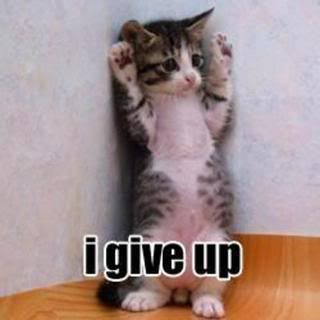
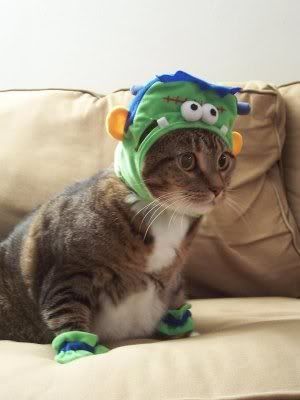
In Honor of the Upcoming Holiday

Halloween is fast approaching, and you know what that means:

Anthromorphizing poor little innocent animals!


Courtesy of Cute Overload.

Cuteness and the Economic Crisis

I read an interesting article over at Change Order, a blog about the integration of design and business.

David Sherwin, who wrote the article, made an interesting speculation: With the recent "financial tsunami" that has hit the world, companies are making a mad dash to merge in order stave off bankruptcy. For example, WaMu's merger with Chase. With that, new questions emerge: What will happen to their branding? And with the unavoidable recession looming in consumers' minds, can cute branding survive?

"WaMu had invested countless billions of dollars to paint a perky, friendly face on money. The WaMu marketing machine had been laser-focused on less-sophisticated, higher-risk consumers, putting forth a friendly facade that was dubbed by their former CEO, Kerry Killinger, as the 'Wal-Mart of Banking.'"

Just check out this ad for WaMu that uses the irresistability of puppies and the adorable tagline "Whoo-Hoo!" to sell its services:


He suggests that this fresh, young image will now serve to repel the very same people it used to attract. And his logic, simply put, is thus:

Cuteness relies on optimism, and optimism relies on prosperity. Without that prosperity, people are no longer looking for the cute, friendly face in advertising. They are looking for a real, grown up, fact-based brand. While I believe this to be true, I also think that cuteness in advertising still has its place.

Advertising relies on one basic thing: happiness. Cuteness can bring that happiness–it can reassure, and in these troubling times, reassurance is key.

Saturday, October 18, 2008

Cute, Quaint, Hungry, and Romantic

I've taken some quotes from Daniel Harris's Cute, Quaint, Hungry, and Romantic: The Aesthetics of Consumerism. This book is far from a study in consumerism–I'd say it is more an anti-consumerist opinion piece. And while Harris makes some interesting connections, his ready-made hatred of anything popular or unrealistic turns any semblance of fact into a wordy rant. He goes so far as to compare teddy bears to adult sex dolls and the act of hugging a stuffed animal to necrophilia. He operates from as distorted a world view as those he demeans:

"The cute world view is one of massive human chauvinism, which rewrites the universe according to an iconographic agenda dominated by the pathetic fallacy... The cute vision of the natural world is a world without nature, one that annihilates "otherness," ruthlessly suppresses the non-human, and allows nothing, including our children, to be separate and distinct from us." (12)

While he completely skips over scientific explanations and evolutionary theories, he does make an important case for the social implications of cuteness, so it's included in my research. Read on for some more quotes:

"Cuteness suggests guilelessness, simplicity, and a refreshing lack of affectation." (2-3)

"Cuteness is not an aesthetic in an ordinary sense of the word and must by no means be mistaken for the physically appealing, the attractive. In fact, it is closely linked to the grotesque, the malformed." (3)

"The grotesque is cute because the grotesque is pitiable, and pity is the primary emotion of the seductive and manipulative aesthetic that arouses our sympathies... The aesthetic of cuteness creates a class of outcasts and mutations." (4)

"Something becomes cute not necessarily because of a quality it has but because of a quality it lacks, a certain neediness and inability to stand alone, as if it were an indigent starveling, lonely and rejected because of hideousness we find more touching than unsightly." (4)

"Cuteness has become essential to the marketplace, in that advertisers have learned that consumers will 'adopt' products that create, often in their packaging alone, an aura of motherlessness, ostracism, and melancholy." (5)

"Cuteness, in short, is not something we find in our children but something we do to them... it almost always involves an act of sadism on the part of its creator, who makes an unconscious attempt to maim, hobble, and embarrass the thing he seeks to idolize." (5)

"Adorable things are often most adorable when in the middle of a pratfall or a blunder." (6)

"Although the gaze we turn on the cute thing seems maternal and solicitous, it is in actuality transformative and will stop at nothing to appease its hunger for expressing pity and big-heartedness, even at the cost of mutilating the object of its affections." (6)

"If cuteness is the aesthetic of deformity and dejection, it is also the aesthetic of sleep." (7)

"The imitative nature of cuteness can also be seen in the relation of the aesthetic to precocity." Precocity is the development of certain capabilities at an earlier age than usual.

Overall, it's a good read, but rather depressing. Time for a kitten picture.


There. I'm better.

Thursday, October 16, 2008

The Science of Cuteness

This is the transcript from a report done by Jeanne Moos of CNN. You can also view the video here. I dare you to get through it without smiling, laughing, or squealing in delight.

JEANNE MOOS, CNN CORRESPONDENT (voice over): Sure hope Shiloh isn't shy, because her face is plastered all over the place

UNIDENTIFIED FEMALE: The lips, the nose, the eyes, the everything.

UNIDENTIFIED FEMALE: Yes.

MOOS: But all this rhapsodizing about the Brangelina baby got us wondering.

UNIDENTIFIED FEMALE: How can you define cute?

MOOS: It's that thing that makes you go...

UNIDENTIFIED FEMALE: Oh.

MOOS: But there is a science to cute, and a poster child is the panda bear. For instance, the cub at Washington's National Zoo.

(on camera): Which one is cuter to you?

UNIDENTIFIED FEMALE: The baby panda.

UNIDENTIFIED FEMALE: The panda.

UNIDENTIFIED MALE: The baby.

UNIDENTIFIED MALE: Oh, that panda bear is so cute.

UNIDENTIFIED MALE: That's a cute baby.

UNIDENTIFIED MALE: And I love children, but I think the panda is just so cute. Look at the eyes.

MOOS (voice over): Researchers say humans react to forward- facing eyes set low on a big, round face, with prominent ears, floppy limbs, and a waddling gate. No wonder folks seem attracted to penguins, both real and animated.

They say cuteness stimulates the same pleasure centers in the brain that are aroused by sex, food and drugs. We say "ah" over the pandas. Photographers even said "ah" over a wax version of the Brangelina baby introduced at Madame Tussauds.

UNIDENTIFIED MALE: That baby is very cute.

UNIDENTIFIED MALE: Probably the panda because the baby is going to turn into a disgusting teenager.

MOOS: Researchers say humans react to the vulnerability of the young.

UNIDENTIFIED FEMALE: I think he kind of shows a vulnerable side.

MOOS: Which is good for evolution, since it brings out protective instincts.

UNIDENTIFIED FEMALE: Hold it. Hold it.

MOOS: There are Web sites devoted to cute, like Cute Overload, which features nothing but cute pictures and videos that people submit. Sleepiness seems to add to the vulnerability we find so appealing.

There's even a section for cute products. And who doesn't see the round face factor in cute cars like the VW Bug and the Mini?

The opposite of cute overload is ugly overload, featuring cow tongues and bats, not to mention El Pacas (ph). But sometimes homeliness can be cute.

One of the most popular stories I have ever done was on Sam, the three-time winner of the ugliest dog contest, now deceased. And as for the smackdown between the panda and the Brangelina baby...

UNIDENTIFIED MALE: This bear is much cuter than that baby. I know that baby cries. And that bear, well, he just looks too damn cute.

MOOS: ... the panda won, 16-12, a vote not worth losing sleep over.

Jeanne Moos, CNN, New York.
Hello Kitty: One Nation Under Cute

This is a short article on the history and social implications of kawaii, the Japanese culture of cute.

"Psychologists believe that cuteness is a function of resemblance to human infants, to whom we're programmed to respond sympathetically because of their helplessness. And Japan may have a surplus of unused parenting instincts, given that the country has one of the world's lowest birth rates (and one of the highest ages of marriage)."

They claim that adults not only substitute cute objects for children, they also wish to be a child. This is an entirely new view on how cute can permeate a culture. It introduces the idea that social rigidity can have a far reaching effect on its members. When you are allowed to be independent at a young age and then forced into a highly structured adult life, you can want so much for your youth that you begin to live it. It is less a statement about cuteness and more about independence. The widespread popularity of cuteness is more a result of intense marketing and a consumer-driven society.

You can read the whole article at Psychology Today.