


Showing posts with label Cute Pictures. Show all posts
Showing posts with label Cute Pictures. Show all posts
Saturday, November 22, 2008

Tuesday, October 28, 2008
Everything's Bigger in Texas
Today marks a proud day in history, as Carnival Cruise Lines broke the world record for "World's Largest Beach Ball" today in downtown Dallas, Texas. The ball neasures 3 stories tall. Awesome? Yes. Cute? Definitely!
Just look at this video taken at the dropping of the beach ball:
I laughed out loud when all the people put their hands up in anticipation to hit the ball. It reminds me of that part in Toy Story where all the aliens are in the claw machine and they look up at the claw and go, "Ooooooo."
This event calls out to our inner children, I believe. Adults have forsaken work time for play time, if only for a few minutes, and I think part of the cute connection relies on the playfulness that this depicts.
Cute Cues:

Just look at this video taken at the dropping of the beach ball:
I laughed out loud when all the people put their hands up in anticipation to hit the ball. It reminds me of that part in Toy Story where all the aliens are in the claw machine and they look up at the claw and go, "Ooooooo."
This event calls out to our inner children, I believe. Adults have forsaken work time for play time, if only for a few minutes, and I think part of the cute connection relies on the playfulness that this depicts.
Cute Cues:
- Roundness
- Unsteadiness (Slowness)
- Smallness in comparison to other objects (People are dwarfed)

Monday, October 27, 2008

Hello Kitty

Cute Cues:
- Small nose
- Eyes and nose set on lower half of head
- Large ears
- Large, rounded head
- Simple geometry
Other points of interest:
- Innocence portrayed by bow tie
- Lack of mouth/voice
Opinions to be developed further. Quotes to be gathered.
Kawaii: The Culture of Cute
Excerpts from Natalie Avella's Graphic Japan: From Woodblock and Zen to Manga and Kawaii.
A Brief History of Kawaii
"Kawaii, meaning 'cute,' must be one of the most loved and most widely used words in Japan. Kawaii essentially means 'childlike,' and, according to academic Sharon Kinsella, who has studied the phenomenon, it celebrates all that is: 'sweet, adorable, innocent, pure, simple, genuine, gentle, vulnerable, weak, and inexperienced in social behavior and physical appearance.' ...The word kawaii is derived from kawajushi, a word that first appeared in dictionaries prior to 1945. It had principal meanings of 'shy' or 'embarrassed,' but possessed secondary meanings such as 'pathetic,' 'vulnerable,' 'darling,' 'loveable,' and 'small.'" (211-213)
"Kawaii first appeared in the 1970s, at the same time as the emergence of a new craze among teenagers, especially girls, for cute, babyish handwriting, ...[which was a rebellion] against traditional Japanese culture and identifying with European culture. ...As the handwriting craze developed, so did a fashion among young adults for childish behavior, baby-talk, and wearing childish clothes. ...Dressing up continues to be practiced by Japanese youth." (213)

"A love of cute characters appears to transcend both age and gender." (211)
"Cute is not just eye candy on the surfaces of consumer products; kawaii characters also function as a polite way of conferring guidance and information to the public. ...In a country where people are brought up on a diet of manga and anime, cartoons are a common language." (212)
"Creating quasi-relationships with cute, inanimate objects is a relief from, or compensation for, the alienation that many people feel." (214)
"For corporate business, kawaii helps to give a friendly face to an otherwise impersonal corporate identity, giving people a way to build a personal relationship with a particular brand." (212)
"Japanese tend to enjoy funny topics for daily conversation, such as 'what kind of dumb things they've done,' or descriptions of their own mistakes. This is an attempt to disarm the listener, and to develop more intimate relationships. Similarly, funny mascots tell you that the owner is friendly and unpretentious." (212)
"In Japan, group harmony is valued above individual expression." (214)
Other Sources for Studies on Kawaii
"Modern consumers might not be able to meet and develop relationships enough with people, but the implication of cute goods design was that they could always attempt to develop them with cute objects." Source: Kinsella, Sharon. "Cuties in Japan." Women, Media and Consumption in Japan. University of Hawaii Press.
"Kawaii gives people a way to hang onto childhood and thereby postpone the pressures of adulthood. ...Adulthood was not viewed as a source of freedom and independence, it was viewed as quite the opposite, as a period of restrictions and hard work. ...Cute fashions idolize childhood because it is seen as a place of individual freedom unattainable in society." (Kinsella)
"Wearing a cute mascot in public is a way to communicate with others like yourself. There is a consensus that a person who likes cute things is good. If you show a funny mascot, people assume that you are an easy-going and open-minded person. Your mascot makes people around you believe you are more approachable. The mascot also" Source: Kato, Miki. "Cute Culture." Eye. Issue 44 Summer 2002.
"If you invite a Japanese acquaintance to dinner, and ask them what kind of restaurant they would like to go to, they will probably answer, 'anywhere you like.' Not having an individual voice is considered a traditional virtue in Japan and this is based on the idea of amae," which means to "act like a child." (Kato)
A Brief History of Kawaii
"Kawaii, meaning 'cute,' must be one of the most loved and most widely used words in Japan. Kawaii essentially means 'childlike,' and, according to academic Sharon Kinsella, who has studied the phenomenon, it celebrates all that is: 'sweet, adorable, innocent, pure, simple, genuine, gentle, vulnerable, weak, and inexperienced in social behavior and physical appearance.' ...The word kawaii is derived from kawajushi, a word that first appeared in dictionaries prior to 1945. It had principal meanings of 'shy' or 'embarrassed,' but possessed secondary meanings such as 'pathetic,' 'vulnerable,' 'darling,' 'loveable,' and 'small.'" (211-213)
"Kawaii first appeared in the 1970s, at the same time as the emergence of a new craze among teenagers, especially girls, for cute, babyish handwriting, ...[which was a rebellion] against traditional Japanese culture and identifying with European culture. ...As the handwriting craze developed, so did a fashion among young adults for childish behavior, baby-talk, and wearing childish clothes. ...Dressing up continues to be practiced by Japanese youth." (213)

"A love of cute characters appears to transcend both age and gender." (211)
"Cute is not just eye candy on the surfaces of consumer products; kawaii characters also function as a polite way of conferring guidance and information to the public. ...In a country where people are brought up on a diet of manga and anime, cartoons are a common language." (212)
"Creating quasi-relationships with cute, inanimate objects is a relief from, or compensation for, the alienation that many people feel." (214)
"For corporate business, kawaii helps to give a friendly face to an otherwise impersonal corporate identity, giving people a way to build a personal relationship with a particular brand." (212)
"Japanese tend to enjoy funny topics for daily conversation, such as 'what kind of dumb things they've done,' or descriptions of their own mistakes. This is an attempt to disarm the listener, and to develop more intimate relationships. Similarly, funny mascots tell you that the owner is friendly and unpretentious." (212)
"In Japan, group harmony is valued above individual expression." (214)
Other Sources for Studies on Kawaii
"Modern consumers might not be able to meet and develop relationships enough with people, but the implication of cute goods design was that they could always attempt to develop them with cute objects." Source: Kinsella, Sharon. "Cuties in Japan." Women, Media and Consumption in Japan. University of Hawaii Press.
"Kawaii gives people a way to hang onto childhood and thereby postpone the pressures of adulthood. ...Adulthood was not viewed as a source of freedom and independence, it was viewed as quite the opposite, as a period of restrictions and hard work. ...Cute fashions idolize childhood because it is seen as a place of individual freedom unattainable in society." (Kinsella)
"Wearing a cute mascot in public is a way to communicate with others like yourself. There is a consensus that a person who likes cute things is good. If you show a funny mascot, people assume that you are an easy-going and open-minded person. Your mascot makes people around you believe you are more approachable. The mascot also" Source: Kato, Miki. "Cute Culture." Eye. Issue 44 Summer 2002.
"If you invite a Japanese acquaintance to dinner, and ask them what kind of restaurant they would like to go to, they will probably answer, 'anywhere you like.' Not having an individual voice is considered a traditional virtue in Japan and this is based on the idea of amae," which means to "act like a child." (Kato)
Friday, October 24, 2008
In Honor of the Upcoming Holiday
Halloween is fast approaching, and you know what that means:
Anthromorphizing poor little innocent animals!


Courtesy of Cute Overload.
Anthromorphizing poor little innocent animals!
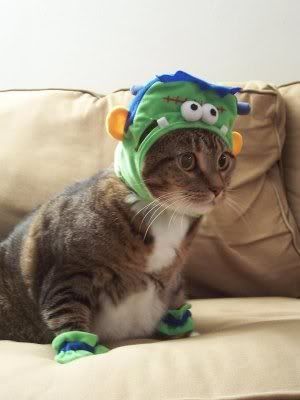

Courtesy of Cute Overload.
Saturday, October 18, 2008
Cute, Quaint, Hungry, and Romantic
I've taken some quotes from Daniel Harris's Cute, Quaint, Hungry, and Romantic: The Aesthetics of Consumerism. This book is far from a study in consumerism–I'd say it is more an anti-consumerist opinion piece. And while Harris makes some interesting connections, his ready-made hatred of anything popular or unrealistic turns any semblance of fact into a wordy rant. He goes so far as to compare teddy bears to adult sex dolls and the act of hugging a stuffed animal to necrophilia. He operates from as distorted a world view as those he demeans:
"The cute world view is one of massive human chauvinism, which rewrites the universe according to an iconographic agenda dominated by the pathetic fallacy... The cute vision of the natural world is a world without nature, one that annihilates "otherness," ruthlessly suppresses the non-human, and allows nothing, including our children, to be separate and distinct from us." (12)
While he completely skips over scientific explanations and evolutionary theories, he does make an important case for the social implications of cuteness, so it's included in my research. Read on for some more quotes:
"Cuteness suggests guilelessness, simplicity, and a refreshing lack of affectation." (2-3)
"Cuteness is not an aesthetic in an ordinary sense of the word and must by no means be mistaken for the physically appealing, the attractive. In fact, it is closely linked to the grotesque, the malformed." (3)
"The grotesque is cute because the grotesque is pitiable, and pity is the primary emotion of the seductive and manipulative aesthetic that arouses our sympathies... The aesthetic of cuteness creates a class of outcasts and mutations." (4)
"Something becomes cute not necessarily because of a quality it has but because of a quality it lacks, a certain neediness and inability to stand alone, as if it were an indigent starveling, lonely and rejected because of hideousness we find more touching than unsightly." (4)
"Cuteness has become essential to the marketplace, in that advertisers have learned that consumers will 'adopt' products that create, often in their packaging alone, an aura of motherlessness, ostracism, and melancholy." (5)
"Cuteness, in short, is not something we find in our children but something we do to them... it almost always involves an act of sadism on the part of its creator, who makes an unconscious attempt to maim, hobble, and embarrass the thing he seeks to idolize." (5)
"Adorable things are often most adorable when in the middle of a pratfall or a blunder." (6)
"Although the gaze we turn on the cute thing seems maternal and solicitous, it is in actuality transformative and will stop at nothing to appease its hunger for expressing pity and big-heartedness, even at the cost of mutilating the object of its affections." (6)
"If cuteness is the aesthetic of deformity and dejection, it is also the aesthetic of sleep." (7)
"The imitative nature of cuteness can also be seen in the relation of the aesthetic to precocity." Precocity is the development of certain capabilities at an earlier age than usual.
Overall, it's a good read, but rather depressing. Time for a kitten picture.

There. I'm better.
"The cute world view is one of massive human chauvinism, which rewrites the universe according to an iconographic agenda dominated by the pathetic fallacy... The cute vision of the natural world is a world without nature, one that annihilates "otherness," ruthlessly suppresses the non-human, and allows nothing, including our children, to be separate and distinct from us." (12)
While he completely skips over scientific explanations and evolutionary theories, he does make an important case for the social implications of cuteness, so it's included in my research. Read on for some more quotes:
"Cuteness suggests guilelessness, simplicity, and a refreshing lack of affectation." (2-3)
"Cuteness is not an aesthetic in an ordinary sense of the word and must by no means be mistaken for the physically appealing, the attractive. In fact, it is closely linked to the grotesque, the malformed." (3)
"The grotesque is cute because the grotesque is pitiable, and pity is the primary emotion of the seductive and manipulative aesthetic that arouses our sympathies... The aesthetic of cuteness creates a class of outcasts and mutations." (4)
"Something becomes cute not necessarily because of a quality it has but because of a quality it lacks, a certain neediness and inability to stand alone, as if it were an indigent starveling, lonely and rejected because of hideousness we find more touching than unsightly." (4)
"Cuteness has become essential to the marketplace, in that advertisers have learned that consumers will 'adopt' products that create, often in their packaging alone, an aura of motherlessness, ostracism, and melancholy." (5)
"Cuteness, in short, is not something we find in our children but something we do to them... it almost always involves an act of sadism on the part of its creator, who makes an unconscious attempt to maim, hobble, and embarrass the thing he seeks to idolize." (5)
"Adorable things are often most adorable when in the middle of a pratfall or a blunder." (6)
"Although the gaze we turn on the cute thing seems maternal and solicitous, it is in actuality transformative and will stop at nothing to appease its hunger for expressing pity and big-heartedness, even at the cost of mutilating the object of its affections." (6)
"If cuteness is the aesthetic of deformity and dejection, it is also the aesthetic of sleep." (7)
"The imitative nature of cuteness can also be seen in the relation of the aesthetic to precocity." Precocity is the development of certain capabilities at an earlier age than usual.
Overall, it's a good read, but rather depressing. Time for a kitten picture.
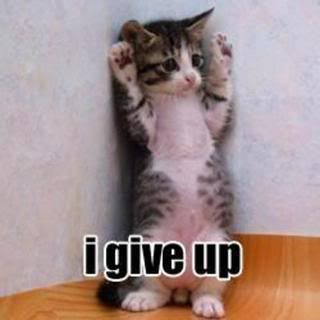
There. I'm better.
Subscribe to:
Posts (Atom)